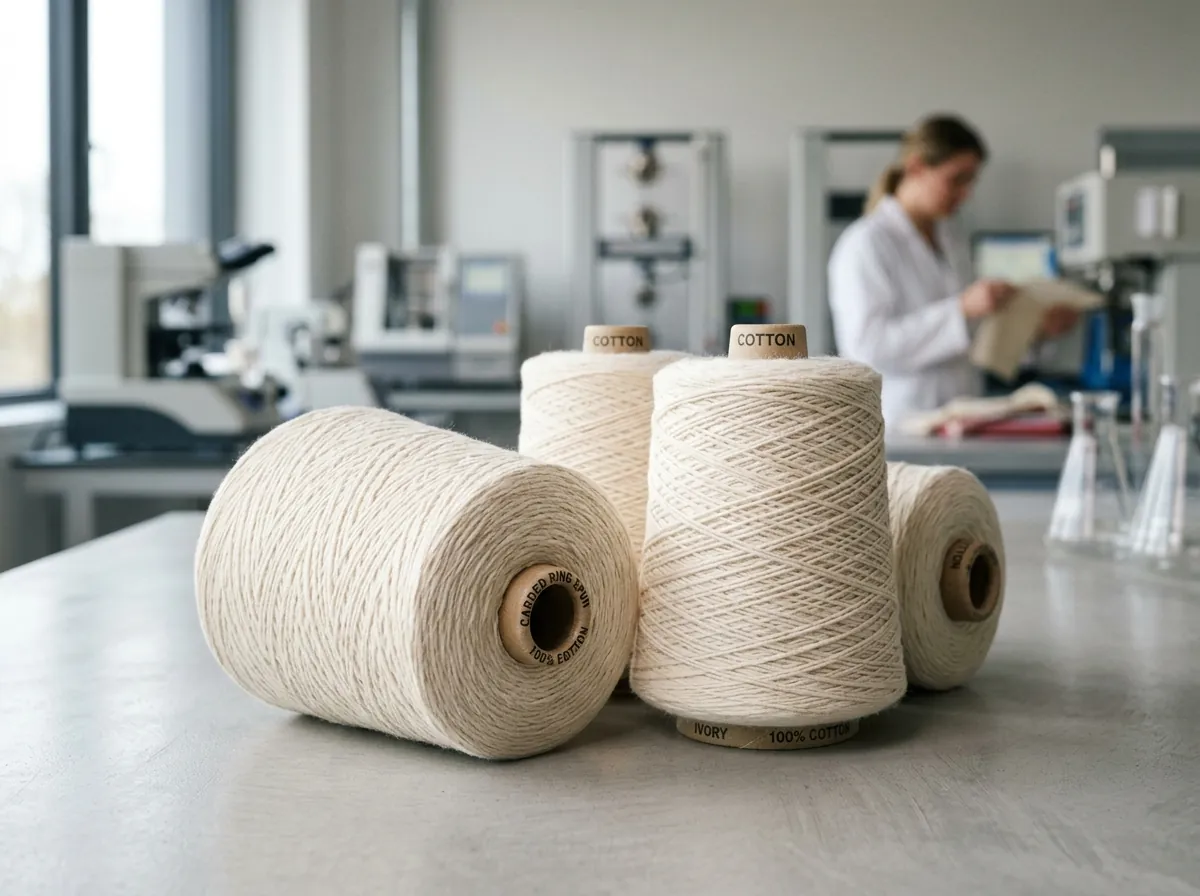
100% Karded Cotton Yarn
AKR Spinning Mills produces 100% karded cotton yarn as our core, signature product — a ring-spun, natural-cotton yarn produced through our complete seven-stage spinning process.
Why Choose Karded Yarn
The Benefits of Karded Cotton
Natural Handle
Karded yarn retains a broader mix of fibre lengths than combed, giving it a slightly bulkier, softer feel — preferred for comfortable everyday garments and towels.
Cost Efficiency
No combing step means less fibre waste (no noil removal) and a shorter process path — making karded yarn the economical choice for applications that don't require the premium finish of combing.
Reliable Consistency
Even without combing, our carding and drawing stages are carefully managed to deliver a consistent count, controlled evenness, and minimal imperfection levels — lot after lot.
Versatile Application
Karded yarn performs across a wide range of end products — from knitted garments and jerseys to towels and shirting fabrics — making it a versatile choice for manufacturers with varied production needs.
Natural Characteristics
What Makes Karded Yarn What It Is
Karded yarn's character is shaped by the carding process itself — the stage that gives this yarn its name. Unlike combed yarn, where short fibres are removed by a combing cylinder, karded yarn retains a distribution of fibre lengths. This is not a flaw — it is a defining characteristic that makes karded yarn what it is.
In fabric, karded yarn produces a slightly softer, more textured surface than combed. For T-shirts, jerseys, and towels — where comfort and absorbency matter more than surface smoothness — these characteristics are an asset.
The slight hairiness of karded yarn also contributes to the softness that end-consumers expect in everyday cotton garments and household textiles.
Cost Efficiency
Value Without Compromise
No Combing Waste
Combing removes 12–20% of fibre as noil. Karded yarn uses the full card sliver — reducing raw material waste and keeping the process cost down.
Shorter Process Path
Karded yarn skips the combing stage entirely. Fewer machines, fewer handling stages, and faster throughput all contribute to a leaner cost structure.
Right Fit for Application
For everyday knitwear, jerseys, towels, and standard shirting, karded yarn delivers the required properties at a cost point that works commercially.
Applications
Where Our Yarn Is Used
AKR karded cotton yarn is currently confirmed for the following applications. Additional applications will be added as verified with buyers.
Knitted T-Shirts & Single Jersey
Suited for producing high quality knitted t-shirts & single jersey based on current specifications.
Terry Bath & Hand Towels
Suited for producing high quality terry bath & hand towels based on current specifications.
Fleece Sweatshirts & Hoodies
Suited for producing high quality fleece sweatshirts & hoodies based on current specifications.
Heavy Weaving & Denims
Suited for producing high quality heavy weaving & denims based on current specifications.
Yarn Count Range
Count Availability
Note on Count Availability: Count range data for AKR Spinning Mills is managed in our product database and updated as our production capabilities are confirmed. Please contact us with your specific count requirement to check current availability.
Yarn Count System
English Count (Ne)
Twist Direction
Z-twist standard; S-twist on enquiry
Ply
Single (1-ply) and plied on enquiry
Understanding Yarn Count (Ne)
Yarn count in the English (Ne) system indicates how many 840-yard hanks of yarn weigh one pound. A higher Ne number means a finer yarn — a 40s yarn is finer than a 20s yarn.
For karded yarn, the practical count range is typically in the coarser to medium segment of the market. Fine karded yarn is possible, but the natural variation from retained short fibres makes combed more suitable at very fine counts. We recommend discussing your count requirement with us directly.
Specifications
Product Specifications
| Parameter | Details |
|---|---|
| Fibre Composition | 100% Pure Virgin Cotton |
| Yarn Type | Karded Ring Spun |
| Count Range | Ne 16s to Ne 40s (Single & Plied) |
| Twist Direction | Z-Twist (S-Twist on enquiry) |
| Evenness / Uster | Tested to Uster Statistics 25–50% standards |
| Packaging | Cones / 24-cone woven export bags or carton boxes |
Technical Comparison
Karded vs. Combed — Which is Right?
| Property | Karded Yarn | Combed Yarn |
|---|---|---|
| Short Fibre Content | Retained (broader fibre distribution) | Removed by combing stage |
| Surface Texture | Slightly textured / hairy | Smoother, more lustrous |
| Strength (Tenacity) | Good for most applications | Higher — due to longer fibre alignment |
| Evenness (U%) | Controlled; monitored at Uster tester | Better — shorter fibres that cause variation removed |
| Hairiness | Higher — contributes to fabric softness | Lower — cleaner, smoother surface |
| Imperfections | Monitored and controlled at card / clearers | Lower — combing reduces neps and short fibre effects |
| Cost | Lower — no combing stage; less fibre waste | Higher — combing waste (noil) adds to raw material cost |
| Typical Applications | T-shirts, jerseys, towels, everyday knitwear | Fine shirting, premium knitwear, fine fabrics |
| Count Range (typical) | Coarser to medium counts | Medium to fine counts |
AKR currently produces karded yarn. If your application requires combed, please contact us to discuss your requirement.
For Buyers
What to Specify When You Enquire
The more clearly you specify your requirement, the better we can confirm availability, lead time, and pricing. Here is what to consider before sending an enquiry.
Yarn Type
RequiredKarded ring spun is our standard. If you are considering karded for an application that typically uses combed, please mention this so we can advise.
Count (Ne)
RequiredThe yarn count you need. If you are unsure, describe your end product (e.g., 180 GSM single jersey T-shirt) and we can suggest an appropriate count range.
Fibre Composition
RequiredWe produce 100% cotton karded yarn. If you need a blend (e.g., cotton-polyester), please specify.
Application
RequiredWhat you are making with the yarn — knitting (and if so, what structure), weaving, terry. This helps us confirm suitability and recommend the right specification.
Quantity
RequiredApproximate order quantity in kilograms or cones. This affects lead time and minimum order discussions.
Ply
OptionalSingle (1-ply) is standard. Two-ply and other constructions are available on enquiry — specify if needed.
Twist Direction
OptionalZ-twist is our standard. S-twist (or specific TPI) can be discussed on enquiry.
Quality Parameters
OptionalIf you have specific Uster or customer quality requirements, please share them. We can review against our tested results.
Packaging Requirements
OptionalStandard delivery is on cones. If you need cone weight, core size, or labelling specifications, mention these in your enquiry.
Delivery Requirements
OptionalExpected delivery destination, lead time requirements, and Incoterms preference.
Quality Assurance
How We Ensure Quality at Every Lot
Uster Benchmark Standards
Uster Technologies publishes annual statistics that benchmark yarn quality parameters — evenness, imperfections, hairiness — against global production averages. These statistics are the industry standard reference for yarn quality assessment.
We test our finished yarn on testing equipment that produces results comparable to Uster statistics. Quality positioning for each production lot can be discussed with buyers on enquiry. We do not publish specific Uster percentile claims without confirmed, current lot data.
Parameters We Test
Lot-to-Lot Traceability
Each production lot is tracked through our process. Quality test results are maintained for each lot and can be made available to buyers as part of the supply relationship. Consistency across lots is a key part of how we approach quality management.
Send an Enquiry
Ready to Discuss Your Requirement?
Tell us your count, application, and quantity. We'll respond with availability, lead time, and next steps. No pressure, no intermediaries — you'll speak directly with the family.
Let's Work Together
Partner With AKR Spinning Mills
Experience the difference of precision-engineered yarns backed by decades of expertise. Contact our team to discuss your specific textile requirements.